 Celebrate the crisp, cold winter snow with this fun math lesson plan for younger kids. These three snow-themed math activities are simple to plan and fit in with any winter-based classroom units.
Snowball Math Materials
For these three math activities, gather together the following materials:
- dark or light blue construction paper, cut into 8 1/2" x 11" pieces
- cotton balls
- miniature marshmallows
- two large jars
- white crayons
- white stamping ink
Money-Saving Tip: Have you noticed how large cotton balls have become lately? Save some money and have a parent volunteer cut your stash of cotton balls in half to make them go farther.
Snowball Addition or Subtraction
This math project helps children create groups of snowballs to show simple addition and subtraction equations. In this case, the snowballs are miniature marshmallows, but the cotton balls can also be used for this math activity.
- Review simple addition and subtraction equations
- Pass out the 8 1/2" x 11" pieces of blue construction paper, one per child, along with a number of miniature marshmallows
- Students glue their marshmallow snowballs onto the paper to show their equations, writing the equation underneath their snowballs
Once completed, these snowball addition and subtraction equations can be hung up as an easy winter-themed bulletin board called Snowball Math!
Snowball Estimation
For this whole-class estimation activity, you'll need the two jars and a bag of cotton balls.
To prepare for this lesson, put 20 cotton balls in one of the jars. In the other jar, put as many cotton balls as you'd like to use for this estimation activity.
Show your kids the first jar and tell them that there are 20 snowballs in it. Then show them the other jar and explain that you have no idea how many snowballs are in that jar. Before you count them together as a class, however, you want everyone to take a good guess.
Discuss with your kids how they could use the first jar to estimate how many snowballs are in the second jar and ask what would make a good guess. Once students have settled on their strategies, go around the room and write down each student's estimation of how many snowballs are in the second jar, making a simple graph on chart paper.
Together with your kids, count the snowballs from the second jar, comparing the final outcome with your students' guesses.
Counting By Fingerprint Snowballs
This is a great activity to reinforce counting and grouping skills. Using the Create a series of snowballs in groups of twos, threes, fours or fives.
Using one 8 1/2" x 11" piece of blue construction paper per child, have them draw three circles on the page using a white crayon (this can also be done beforehand).
Using a stamping pad of white ink (one per group of students), have your kids put a series of thumbprints in each circle - for example:
- instruct students to put groups of two thumbprints in each circle and write the total number of groups of two on the bottom of the page. Change the amount of thumbprints that go in each circle based on the skill level of your kids.
- change the focus of the lesson from counting and grouping to addition or subtraction by instructing your students to create simple equations using their fingerprints in the circles and writing the equation underneath the circles.
- in each circle, have students stamp groups of two, three, and four, one set in each circle. Add circles to the blue paper as needed to expand the counting and grouping exercise.
Another option is to avoid putting the circles on the page to begin with, and simply having kids stamp fingerprints in groups beginning with the number one through the number ten, writing the corresponding number under each set of fingerprints.
Regardless of how you use this math lesson plan with your students, don't forget that the results can be used as an easy and cute bulletin board in your classroom or out in the hallway to help everyone celebrate the winter months!
 The essence of who we are today largely depends on how we were educated as youngsters. Because early educational development is the precursor to our more advanced education, it is vital that parents take an active participation in helping to form the cognitive functions of their child’s minds. One of the most critical skills that your child will need to learn early on is that of counting, so let’s take a look at how to get your toddler interested early.
Counting makes up the basic principles of mathematics as well as in everyday life and should be one of the very first concepts your child attempts to learn. As numbers will always be a part of our daily existence, teaching your child to count should begin even before they reach preschool. The problem, though, is that children at this age are more inclined to playing than learning. So, how do you get to keep your little tykes interested in counting? The answer may be simple: Integrate fun into your teaching methods.
1. Counting Fingers
The concept of counting should be indoctrinated in your child’s mind even during their infancy. Even at a very young age, a child’s brain can already function and retain basic information. When giving your baby a bath or when changing their clothes, make sure to count aloud each of their tiny fingers and toes. When they reach the terrible two’s, try counting some of their sweets before they eat them.
2. Counting Rhymes
Fortunately, there are an array of sing along rhymes that have proven to be very effective at capturing the interest of toddlers. Music and sounds are great ways to get your children to count along with fun nursery rhymes they can easily understand and recall. You can also play these sing along counting rhymes in the car to help your child retain their interest in numbers.
3. Counting Blocks
When your child reaches the toddling age and begins to play on his or her own, you can give them different sets of connecting blocks to play with. While they keep busy trying to build the tallest tower, ask them to count how many blocks they are able to use. This will help your child harp on their mathematical skills as well as boost their imagination and enhance creativity.
Oftentimes, you do not need fancy books or toys to teach your child to count. When shopping, give your child the freedom to count items, like the number of cereal boxes, sodas, or potatoes that you buy. Little kids want to be just like grown-ups, so allow them to pay for your small purchases so they can learn to count money as well as perform simple addition and subtraction tasks. When going up or down a flight of stairs, ask your toddler to count each step, or you can have them count the number of houses you pass by when driving around the neighborhood.
The key to effectively teaching your little one to count lies in how much fun you can make it for them to do. With these easy tricks, you can be assured that your child will be able to count on their own in no time.
Those of us at AccountingDegree.net fell in love with math at a very young age. If numbers and logic put a smile on your face consider researching your accounting degree program options, such as these online MS in accounting. A love of numbers can lead to a great career.
The Math in My Life Project Lesson Plan provides a fun opportunity for you to see what kinds of connections your kids have made regarding math in their every day lives. It also answers the age-old question, "When am I ever going to use math, anyway?"
This fun math activity will keep your students busy this summer!
Ms. Robin teaches students how to save and count coins.
Materials:
- Saving Summer Coins Chart and Jar Label
- Jar or Coffee Can
- Pencil
- Coins (Students find coins over the summer.)
Instructions:
Teacher
- This activity can be started at school and completed at home with Summer Fun Journals (optional).
- Print one Saving Summer Coins Chart and Jar Label for each student.
Students
- Color the label.
- Cut out the label.
- Glue the label onto the jar or coffee can.
- Complete the worksheet as you find coins.
More Fun Summer Work:
- Summer Bridge Workbooks (reading, math and social studies)- Improve reading, especially during the summer months, to connect students from one grade to the next.
Your students will learn about science (magnetism) and math, as they play this fun Winter Olympics Speed Skating Game.
It's a great game to keep in your game cabinet, too.
Materials:
- Free Winter Olympics Speed Skater Race Template
- Box
- Glue
- 2 paperclips (1 per game piece. Two players at a time is recommended for this game.)
- Crayons or colored pencils
- 2 strong magnets (One for every game piece. I’d recommend 2 for this scale. Test the magnets strength before you make the craft. Hold the magnet under a sheet of paper. Set a paperclip on top. Can it easily drag the paperclip? If it is difficult to do you may need a stronger magnet. The game piece will be taped to the paperclip, so it needs to have a strong magnetic pull.)
- Timer (shows seconds)
- Pencil and paper to record time
Instructions:
Game Pieces
- Color and cut out the Winter Olympics Speed Skating template.
- Fold the game pieces in half and tape at the bottom.
- Tape or clip a paperclip under each skater.
Speed Skating Game Rink:
- Color the speed skating game rink (page 2).
- Cut a 7.5 X 10 inch hole in the box.
- Glue the speed skating game rink template over the hole in the box along the edges & let it dry completely.
Game Instructions:
- Set your Olympic skater athlete game piece on the starting line.
- Put your magnet underneath the Olympic skater athlete game piece.
- Test out the magnet to make sure the paperclip and magnet have a strong magnetic pull. Make any needed adjustments. Make sure your friend is all ready to go, too. (warm-up)
- Say, “On your mark. Get set. Go!”
- Pull your Olympic athlete speed skater towards the finish line using the magnet underneath the paper.
- The first speed skater to reach the finish line wins!
- What is your time? Record your time.
- Have several races and practice division by calculating your average time.
Here's a reference list for quick and easy lesson plan ideas this week!
Take a peak under each heading for free lesson plans and printable templates.
Language Arts & Writers' Workshop:
Math:
- Scarecrow Math - Free printable. All elementary grades can enjoy this lesson. Teaches addition, subtraction, multiplication and division.
- Pumpkin Patrol Math - You'll need a pumpkin for this one.
Science:
Crafts:
Poems & Songs
Online Games for the Computer Lab:
More Surprises This Week:
We add more each week, so be sure to bookmark this page and check back soon.
The pumpkin seed math game is perfect to use while studying addition or multiplication. You may like to keep it in a box inside your game cabinet to use on rainy days, too.
Materials:
- Free "Pumpkin Seed Math Game" Template
- construction paper (orange for pumpkin & green or brown for stem)
- cardboard
- egg carton
- tape or glue
- pumpkin seeds or beans (1 seed per student)
- black marker
- A piece of scratch paper to keep track of scores.
Instructions:
Day #1
Teacher
- Use the free template to trace a pumpkin onto the cardboard.
Students
- Cover the cardboard pumpkin with orange construction paper.
- Glue or tape on the green stem.
- Cut out 7 cups from the egg carton.
- Paint each cup yellow. (Let the paint dry.)
- As the paint is drying, write a number "2" (or whatever # you want to practice) on each seed with the permanent black marker. (1 seed per student).
Day #2
- Write the numbers 1-7 inside each yellow cup.
- Glue or tape the cups to the orange pumpkin in the shape of a Jack-o'-lantern.
Play the Game
Each student has 3 beans or pumpkin seeds. Each seed has the number of study on it (e.g. 2)
Try to throw the seed/bean inside the cups. Each time you make it in the cup add or multiply (depending upon if you are studying addition or multiplication) the total on the seed and the cup. For example, if you have 2 on the seed and you have a 5 on the cup and you were studying addition, you would add 2 + 5 = 7. (If you were studying multiplication, 2 x 5 = 10.)
Let each student playing the game do this three times. Take one turn and then give the seed to your neighbor. You will take turns until you each have three tries.
The person with the highest score wins.
Additional Uses:
Different Season - You could also make a heart, apple or snowman instead of a pumpkin.
Division or Subtraction - You could also use the number on the seed and the number in the cup in a subtraction or division problem.
Differentiate Instruction - After assessements, you can assign each student a seed with the number most challening to him. For example, if the student finds multiplying by 3 challenging. Give the student a seed with the number 3 on it.
For the most part, kids like anything sweet. So why not share a math activity with them that's all about chocolate? You might want to do your own first, especially if you are secretive about your age.
![tangram-alphabet[1]](../../../s/files/1/0255/7841/t/1/assets/blog_tangram-alphabet1-150x150_1427.jpg "tangram-alphabet[1]")
Tangram Alphabet: Building Letters With Tangrams is a deceptively simple conceptual resource for teachers. It's a quick read, and all the more valuable for the possibilities it offers students across the curriculum.
If you've not used tangrams in your classroom before, they are pieces taken from a square; the pieces are called tans. The pieces fit together to make larger shapes that resemble what they represent. The beginning of this teaching resource explains what they are and how to use them, as well as tips to get startedand basic lessons. Included also are suggested reading and language arts lessons to further expand your students' experience or to work with older kids.
As students are exploring using tangrams, this resource offers a natural transition. The pages are two-sided sheets, each one with a letter from the alphabet. One side has a letter with the tangram shape outlines and the other side has the same letter, but without outlines. There are also several sheets of Tangram squares to photocopy as needed.
Advantages to utilizing this book include:
- Exploring geometric concepts, problem solving and spatial skills
- Practice fine motor skills
- Letter recognition and sound recognition opportunities
- For use with small groups and centers
Tangram Alphabet: Building Letters With Tangrams is a great resource for combining math and literacy through the use of math manipulatives and letter recognition activities. It's a great resource for any teacher's library!
1. Photocopy tangram squares onto heavy paper, laminate and cut. Keep the pieces of each tangram square together, placing them in envelopes or sandwich bags that seal (this would be great for parent volunteers!). There should be one square per bag or envelope.
2. On the back of each tangram piece, place a small piece of a magnet cut from a larger roll (these usually have adhesive on the back and are found in office supply or craft stores). Put the pieces of each square back into its bag or envelope, keeping them together.
3. Photocopy each tangram letter onto a transperancy.
4. Tape the transperancy to a write-on, wipe-off lap board.
5. During center time, students can use the magnetic tangram pieces with the transparent letters taped to the boards, moving pieces around until they find the correct configuration. This would be a good way to help introduce tangrams as well as reinforce skills without the outlines of the shapes within the letters. And, use them over and over again!
[caption id="attachment_1499" align="alignright" width="249" caption="Doing math with dolphins makes this learning activity a LOT more fun for your kids!"]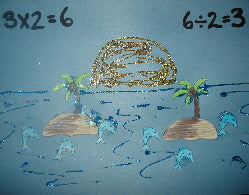 [/caption]
Each Dolphin Multiplication & Division craft represents a multiplication & division problem.
Dividing the dolphins swimming around each island solves the division problem.
Multiplying the dolphins swimming around each island solves the multiplication problem.
Materials:
Directions:
- Decide what the numbers will be. (e.g. 3 x 2 = 6 and 6 ÷ 2 = 3)
- Color & cut out the dolphins and islands to make the problem.
- Glue the dolphins swimming around the islands to create the problem.
(e.g. 2 islands, 6 dolphins, 3 dolphins swimming around each island.)
- Write the numbers showing the problems underneath the picture showing the problems.
(e.g. 3 x 2 = 6 and 6 ÷ 2 = 3)
