 The essence of who we are today largely depends on how we were educated as youngsters. Because early educational development is the precursor to our more advanced education, it is vital that parents take an active participation in helping to form the cognitive functions of their child’s minds. One of the most critical skills that your child will need to learn early on is that of counting, so let’s take a look at how to get your toddler interested early.
Counting makes up the basic principles of mathematics as well as in everyday life and should be one of the very first concepts your child attempts to learn. As numbers will always be a part of our daily existence, teaching your child to count should begin even before they reach preschool. The problem, though, is that children at this age are more inclined to playing than learning. So, how do you get to keep your little tykes interested in counting? The answer may be simple: Integrate fun into your teaching methods.
1. Counting Fingers
The concept of counting should be indoctrinated in your child’s mind even during their infancy. Even at a very young age, a child’s brain can already function and retain basic information. When giving your baby a bath or when changing their clothes, make sure to count aloud each of their tiny fingers and toes. When they reach the terrible two’s, try counting some of their sweets before they eat them.
2. Counting Rhymes
Fortunately, there are an array of sing along rhymes that have proven to be very effective at capturing the interest of toddlers. Music and sounds are great ways to get your children to count along with fun nursery rhymes they can easily understand and recall. You can also play these sing along counting rhymes in the car to help your child retain their interest in numbers.
3. Counting Blocks
When your child reaches the toddling age and begins to play on his or her own, you can give them different sets of connecting blocks to play with. While they keep busy trying to build the tallest tower, ask them to count how many blocks they are able to use. This will help your child harp on their mathematical skills as well as boost their imagination and enhance creativity.
Oftentimes, you do not need fancy books or toys to teach your child to count. When shopping, give your child the freedom to count items, like the number of cereal boxes, sodas, or potatoes that you buy. Little kids want to be just like grown-ups, so allow them to pay for your small purchases so they can learn to count money as well as perform simple addition and subtraction tasks. When going up or down a flight of stairs, ask your toddler to count each step, or you can have them count the number of houses you pass by when driving around the neighborhood.
The key to effectively teaching your little one to count lies in how much fun you can make it for them to do. With these easy tricks, you can be assured that your child will be able to count on their own in no time.
Those of us at AccountingDegree.net fell in love with math at a very young age. If numbers and logic put a smile on your face consider researching your accounting degree program options, such as these online MS in accounting. A love of numbers can lead to a great career.
With the educational apps of the iPad, you and your students can experience the joy of studying new discoveries with the power of multi-touch and media. The following dowloadable apps for the ipad offer kids fun and educational ways of interacting with curriculum and technology, with some fun added as well!
1. MathBoard
One of the best integer practice apps or programs. An amazing app that allows kids to work on addition, subtraction, multiplication, and division problems is MathBoard. With the innumerous customizable options, make math fun for kindergarten kids. Download it at http://itunes.apple.com/us/app/mathboard/id373909837
2. Dinosaur Zoo
This isn't your average zoo. Your kids can learn about and interact with dinosaurs, including important facts such as the latest paleontology discoveries and the study of prehistoric maps regarding where dinosaurs roamed the earth.
Download it at http://itunes.apple.com/us/app/dinosaur-zoo/id435085300
3. Powers of Minus Ten - Cells and Genetics
With the power of Minus Ten app, you can actively zoom into human palm and explore environments with 3D display. Learn the basics of biology and the structures of certain key cells, molecules, and proteins that exist in our bodies. Download it at http://itunes.apple.com/us/app/powers-minus-ten-cells-genetics/id429123553
4. Fish School HD by Duck Duck Moose
Fish School welcomes you to have fun with numbers, alphabets, colors, and more! The creators of Wheels on the Bus bring an award-winning, educational iPhone app. This app is the winner of the Parent’s Choice Gold Award 2011 and the Children’s Technology Review Editor’s Choice Award from Parents’ Choice Foundation. Download it at http://itunes.apple.com/us/app/fish-school-hd-by-duck-duck/id367567922
5. Intro to Letters by Montessorium
Accredited in the Apple iPad commercial ("iPad is Electric”), and one of the best iPad app 2010 is Intro to Letters. This app allows students to have fun and learn at the same time while reading, writing, tracing, recording letter sounds, practicing letter names and working with phonograms under Montessori methodology. Download it at http://itunes.apple.com/us/app/intro-to-letters-by-montessorium/id387232375
6. TED
A great app for older students, TED’s official app for the iPad consists of presentations from some of the most charming and appreciated people round the globe in subjects that include medical dynamics, education, technology, business principles, and music, among others. Over 900 TEDTalk videos are available on the official TED app on iPhone and iPad. Download it at http://itunes.apple.com/us/app/ted/id376183339
7. Star Walk for iPad - an interactive astronomy guide
This astronomy app allows your students to watch the sky during the day or night. This iPad app is well-known and awarded, including the Achiever of Apple Design Award 2010 and certified by Apple as the Best App of 2009 and 2010. Allow your students to observe the constellations, stars and satellites by simply pointing the iPad at the night sky. Download it at http://itunes.apple.com/us/app/star-walk-for-ipad-interactive/id363486802
8. GeoMaster Plus HD
A fun way to learn about geography using interactive games in this iPad app. High-resolution maps including 8 games and an atlas can be enjoyed with this new version. Download it at http://itunes.apple.com/us/app/geomaster-plus-hd/id464061812
If you're using iPad technology in your classroom, we'd love to know about it! What apps help your kids interact with curriculum? How do you use iPad technology in the classroom?
This guest post is affiliated with Working Host Gator Coupons lists the daily changing coupon codes for hostgator hosting services that can get you discounts of more than 90% on selected plans like windows servers
Take a joyride with solar car science fair projects. Capture the opportunity to learn how to create a solar car and discover fun ways that solar energy can be used. With this experiment, you will realize the strength of photovoltaic solar panels and how it’s used to give power to cars. All you need is a little creativity and you’re sure to be a huge success at your next science fair at school.
Solar Car Experiment Process
1. Think of an interesting objective that you want to explore with your solar car. You will notice that you will be most satisfied when you answer a question that you most likely want to know
Examples:
- How much solar energy of the photovoltaic cells needs to be exposed to sunlight for the solar car to be powered for the whole day?
- Will the solar car only need one hour of solar energy charging or a whole day of solar charging?
- Either way, how long will the solar car run with each charge?
Be creative and explore all points of interest. There are tons of sites that are good resources to help you get your information.
2. Create a hypothesis of what you thing may happen.
3. Gather all materials needed to accomplish your experiment. Know the basics of what the components of a solar car are. Look to Super Science Fair Projects website for unique ideas and additional materials that you may need to complete your experiment such as time measure instruments.
4. Create the course of action of how you conducted your experiment with a detail explanation of the step-by-step process to get the final conclusion. You should include all data (photos and time charts) for a clear observation.
5. The conclusion is the final step. Summarize the results that you gathered from completing the experiment. Basically restating your hypothesis and the all the data gather from charging you’re solar.
6. Include any reference information from sites, books or articles that was collected and used which assisted you with your experiment. This just gives your credibility and tools for completing a thriving project in the future.
There are many options for solar car experiments. Now you can use fuel cells and hydro-solar cars for your science fair projects. With a little drop of water and miniature care you can create an excellent project!
Madeline Binder, MS. Ed. has been involved in environmental issues since the '70s. As an educator she believes it is important for students to be engaged in renewable energy solar science fair projects as a means of influencing future decision makers. "Your young scientist is our planet's future!"
Geocaching sounds like a sort of magical activity. Really, geocaching is more like a treasure hunt. Except the treasure is probably not a pot of gold.
So, what exactly is geocaching? On the most basic level, it is using GPS tracking to find hidden objects. There is more to it than this, though.
Online Geocaching Communities
Run an Internet search on "geocaching." You will likely get pages of results. When you look at these results, some will be informational, like this one. Other geocaching websites will give out tips on the subject. While both of those types of sites have their place, you are looking for a third type of site. One that will give you the specific information you need to find a cache.
In order to start geocaching, you will need to find a community that provides a place to both look up geocache coordinates and post them. Usually these websites will have forums where people post successes, clues and experiences they have with a specific geocache.
Some state governments have even gotten in the act and created pages for geocaching in state parks. Geocaching.com is the big daddy sites of this activity. Smaller geocaching websites include opencaching.com and navicache.com.
Where to Locate Geocache Coordinates
Create an account at Geocaching.com. It's free for the basic service and only requires you have a valid email address. Once you have created an account, you will have access to the listings of geocache coordinates. You can locate caches by zip code, town, state or even by country.
Once you complete your search, a list of caches with specific information will appear. The caches have a variety of information attached. The size of the cache as well as the difficulty rating is included. For easy hunts, look for the caches highlighted in green. A printable log with clues is available, along with coordinates and even a printable map.
Equipment Needed
Few items are actually required to start geocaching. Like any other activity, hobby or sport, the more you get into the activity the more items you discover will help you on your quests.
The basics you definitely need include a handheld GPS, a printout of the cache information you are looking for, a pen and a pencil, water and some good walking shoes.
Experienced geocachers have a myriad of things they carry with them on their treasure hunts. A cell phone, camera, flashlight, tweezers, and a first-aid kit are all practical to add to your bag. Bring along some small treasures so you can swap out what is in the cache if you find something cool. Compasses, patches (to sew on a jacket) or a small collector coin are a few possibilities. Paper to add to a full logbook is another item for your pack. Personal preference and needs play a role in what you will bring along on your hunt.
What Now?
You have your GPS coordinates. You have your equipment gathered together. Get your shoes on and head out the door. When you find the cache, sign the log. Then get back on the website and log your experience so others can benefit from your experience.
This post made possible by guest blogger Peggy Crippen, a writer with varied interests, including translation services, GPS tracking and geocaching.
Image: graur razvan ionut / FreeDigitalPhotos.net
Can you imagine a Triceratops and Tyrannosaurus Rex in battle? Your students will enjoy using their imagination as they identify physical adaptations the Triceratops developed to help it survive while foraging for food and fighting in a battle.
Materials:
Instructions:
- Read the Triceratops facts.
- Identify physical adaptations the Triceratops developed to help it forage for food and fight in a battle.
- Color the Triceratops.
Extra Credit:
- Do your own research about the Triceratops. Create more arrows and label each arrow with additional physical adaptations (optional activity can be used to help differentiate the lesson).
- Get another sheet of paper and use research materials (such as dinosaur books) to draw a Triceratops and T-Rex in battle. Write a story about the battle.
Recommended Reading:
We Both Read About Dinosaurs
Your students will enjoy learning about the Velociraptor as they understand important facts and identify physical adaptations.
Did you know that recent research has found that the Velociraptor likely had feathers? Velociraptor was a fierce hunter and may have been very intelligent. Print out this Velociraptor Facts and Coloring Page to learn more.
Materials:
Instructions:
- Read about the Velociraptor.
- Then, study the Velociraptor's body.
- Write down the physical adaptations that helped the Velociraptor capture prey next to each arrow.
Recommended Reading:
We Both Read About Dinosaurs
The 100th day of school is almost here! Here's an activity that's educational, differentiated and fun for your students.
This printable has been designed to use after assessing your students' prior knowledge. It is meant to be differentiated, depending upon the student's needs.
Materials:
Instructions:
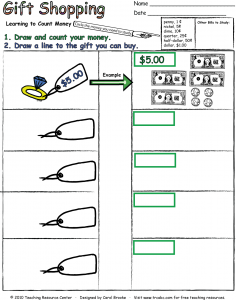
1. After completing pre-assessments, the student circles the money he/she needs to study.
2. Student draws the amount of money on the right side. Then, the student writes the amount inside the green box.
(E.g., Drawing a simple circle with "25" inside the circle, can symbolize a quarter. Drawing a rectangle with a dollar sign and "1' can symbolize a dollar.)
3. Student draws the gift on the left side. Then, the student writes the purchase price of the gift on the tag.
3. Students draw a line from total amount of counted money to the gift they can buy with that amount. (Needs to be the exact amount.)
Notes:
- On the upper-right of the printable, you will see "other bills to study". This can be used for larger bills (e.g. $5, $10, $100, etc.)
- Here's a Gift Shopping, Learning to Count Quarters and Dollars printable.
- Students can use pretend money as they count. (optional).
More to Help Students Learn about Money:
Materials:
Instructions:
While using real money as visuals (or realistic looking money for teaching), the teacher reviews:
- 1 quarter = 25 cents/pennies
- 2 quaters = 50 cents
- 3 quarters = 75 cents
- 4 quarters = 1 dollar
1. Students learn to save money, as the example shows on the printable.
2. Then, students learn to count dollars and quarters.
3. Students draw a line from total amount of counted money to the gift they can buy with that amount.
More to Help Students Learn about Money:
This printable book is ideal for a back-to-school lesson about telling time.
Students create their own stories and learn to tell time.
Materials:
Instructions:
- Create a book as an example before the lesson. (It can be helpful to make the hour red and the minutes blue on both the digital and analog clock.) Bumble Bear is a character in a book I wrote while I was teaching 2nd grade Writer's Workshop.
- Review telling time (analog and digital) using a large clock in your classroom. If you don't already have an instructional clock, here's a free, printable clock. If you are looking for a new morning meeting set, here's an instructional clock to purchase as part of your Morning Meeting Bulletin Board Set.
- Read your Telling Time Book to the students.
- Discuss and write adjectives and verbs on the board. Explain that the book they create will include adjectives and verbs. (e.g. pages 3, 9 and 11).
- Students decide on a character.
- Students write and illustrate their books. (Use pencils, so corrections can be made.)
- Students help each other proofread.
- Students share their books.
- Display books on your classroom bulletin board (optional).