 Good eating habits don't just miraculously develop in a child's life, they have to be shown the way by demonstration and repetition. As with most habits, it is very important that the proper eating guidelines are taught as early as possible, so that there is more chance they will be followed as the years go on. In this article, you will learn exactly how to encourage good eating habits in your kids, so that they can lead a more healthier lifestyle.
Limit the Sweets
One of the worst things that you can do is to get your child used to eating sweets at an early age. This often leads to the child developing a sweet tooth as they get older, which can be very hard to overcome with just willpower. It is much better to limit the amount of sweets they can eat from an early age, and just save these kind of foods as treats for special occasions.
Serve Smaller Portions
Another way you can encourage good eating habits in your kids is to serve smaller portions at meal times. The key is to give them just enough food to fill them up, so that they are not hungry and leave the table satisfied. Serving larger portions can get kids into the habit of eating way more food than their body requires, which of course ends up leading to obesity.
Make Healthy Foods Fun
One of the main reasons why kids don't enjoy eating healthy foods is because they see them as dull and boring. You can overcome this by making foods such as fruits, salads and vegetables fun and exciting. Consider making tasty dips that vegetable pieces can be dipped into, or fruit smoothies which are easy to drink and taste great with a combination of flavours.
Gather 'Round the Kitchen Table
In order to get your child focused on what he or she is actually eating, then it is important to have them seated at somewhere like the kitchen table with the whole family. If you let your kids eat their meals while watching television or playing video games then it is very easy for them to “zone out” and not pay attention to what or how much they are eating.
Eliminate Unhealthy Snacks
Another way you can encourage healthy eating habits in your children is to avoid buying and giving out large quantities of unhealthy snacks such as candy bars and potato chips. This is not a good habit for them to get into, and it is much better to encourage them to try out healthy snacks if they get hungry in between meals. Again, the key is to make these healthy snacks fun and interesting, so they will want them on a regular basis.
Demonstrate Good Eating Habits
The best way to encourage healthy eating habits is by demonstration. If you don't follow a good diet then why should your child listen when you try to get them to eat a salad? If they saw you eating a big chocolate bar an hour earlier, then that is exactly what they are going to want as a snack, not some salad. Demonstration is a very powerful thing, and if your kids see you doing the right things then they will want to follow suit.
If you are looking for ways on how to encourage good eating habits in your kids, then it really isn't that hard. The key to all of this is consistency, as this is how habits are formed. If you consistently give them healthy snacks, then eventually they will begin to accept that as the norm, and not protest that they want something else.
Guest article provided courtesy of Claire, owner of eFoodProcessorReviews.com – an excellent consumer resource for food processor reviews. We also provide the most important info that you need to know about the Braun multiquick 3 k650.
Image: nuchylee / FreeDigitalPhotos.net
 As a parent, you do all you can to give your child a good night's sleep. The mattress is comfortable, the room is warm and the decor is soothing. Parents know that rested kids are happy kids, but did you also know that making sure your child gets enough sleep could actually enhance their ability to learn?
IQ, Learning and Sleep
Sleep is so important to a child's ability to learn that even 30 minutes extra can make a huge difference. The results of an experiment done with 11 to 12-year-old children revealed that if kids lost 30 minutes sleep every night over three days, their performance in school was more like that of a 9 to 10-year-old. Tests have also shown that around 35 minutes of sleep each night stands between A grade students and D grade students.
Allowing children to stay up later on weekends can also be detrimental to their development. The change in bedtime disrupts the routine and makes it harder for kids to get back into a good sleep routine during the week. Studies done at Brown University in America have shown that every hour of lost sleep at the weekend causes a loss of seven points on a standardised school test.
How Much Sleep?
Studies by the Sleep Foundation have shown that different age groups require different amounts of sleep and that the need for sleep decreases as children mature. Toddlers from one to three years need between 12 and 14 hours of sleep during a 24-hour cycle and this will probably be made up of normal night time sleep and naps during the day. Children between the ages of five and 12 years need 10 to 11 hours of sleep, with the number gradually decreasing as they go through their teen years.
The Problems
Children are often over stimulated just before bed and find it hard to switch off. Very young children may be afraid of 'missing something' and force themselves to stay awake long beyond the point at which they feel tired. This results in overactive or hyperactive-type behaviour where the child appears wide awake but is actually exhausted. Children can easily reach the stage where they're literally too tired to sleep.
The Solutions
Many parents have difficulty in getting children into bed at a reasonable time, but in order to maximise their child's alertness during the day, encouraging kids to sleep is vital. Known as 'optimal alertness', kids who've had the correct number of hours of sleep are at their most receptive and can most easily absorb learning.
Establishing a routine at bedtime is one way of combating the problem, as is encouraging quiet pastimes an hour before bedtime. You can try making it a rule that all televisions and computer games are switched off and mobile phones are out of reach. The final hour before bedtime should be a time to unwind and relax away from the external stimulation of electronic gadgets.
Children who still enjoy a bedtime story will appreciate being tucked in with a favourite toy while you read them a familiar story. Make it a happy or funny story and one that's not too exciting or scary. The idea is to calm and relax the child rather than stimulate them.
Every parent wants their child to do as well as possible in school. Ensuring the child gets the proper amount of uninterrupted sleep each night, in a comfortable bed and a quiet, darkened room is one of the best ways of helping your child reach their full learning potential.
[caption id="attachment_6639" align="alignleft" width="160" caption="Photo by woodleywonderworks"][/caption]
Social media and social networking has become more and more popular on account of Facebook and MySpace. Social networking sites have many different uses based on the interests of the user. Although Facebook and MySpace started out for friends to connect, users are now able to create groups to connect of those with similar interests and create business profiles to use being a marketing tool.
Originally these websites have been targeted towards college and high school graduation kids; however, the age demographic has been growing older. The phrase My Mom is on Facebook became a popular joke and even started an Saturday Night Live skit.
A Changing Demographic
The age of users has also been getting younger and younger in the past few years. Although there does exist an age limit of 13 years old on most social media sites, kids are still going on and creating accounts under a false age. This limit is necessary as a result of mature content and to safeguard kids from online predators. There are a number on social networking sites that are zeroed in on towards kids younger than 13 and their parents. There are several items to consider when choosing the right social networking website for young kids.
Evaluate the Website
Parents need to be aware of the websites their children are using and evaluate if these sites are safe. Parents need to determine how often this article and communication is monitored. The site should have safety and security rules and privacy policies posted on their site. Safe social networking sites should have TRUSTe Children’s Privacy close, ESRB Privacy Online Method seal, or VeriSign Secured seal visible to moms and dads. Parents need to discover if there are any inappropriate links or ads on the site. All content must be age appropriate in the event the site is specifically zeroed in on towards kids under age 13.
Ask Questions
After choosing the correct social networking site there are a few follow-up questions that moms and dads should ask. Parents need to ask their kids about what they would like to use the social networking site for and what content they are uploading and posting for their friends to see. Make sure they know the type of information that needs to be kept private such as where they go durring the day. Most sites have level of privacy settings and parents need to make sure that their profiles settings are set for strict privacy. This protects strangers from preying on small children. Parents should also create their own accounts to be able to monitor what their kids are posting and who they are friends with.
Benefits of Social Networking Sites for Kids
Kids social networking sites have many positive aspects and kids should not be discouraged from using these sites. Social networks allow kids to make friends with children from around the world and keep in touch with old friends who have moved away. Kids can join or create groups to connect with other people who share similar interests as them. By creating their own personal profiles, kids are able to express themselves in their own personal space and discover precisely what interests them. Several sites offer online educational tools to help kids with their studying. With the right blend of fun, learning, and parental involvement kids and tweens can enjoy themselves on social networking websites.
About the Author: This article was written by a writer for Kids Social Network.
 Children make excellent fundraising partners. Major organizations, like the Girl Scouts and Boy Scouts, know that it's difficult to turn away an earnest child trying to earn money for a cause that's important to him or her. That said, not all fundraising ideas are suited for younger volunteers. The following are 10 excellent fundraising ideas for kids:
- Door-to-door sales. As mentioned, big organizations know the power of a cute child turning up at your doorstep asking for your help in supporting his or her cause. Select a product that's different than what other organizations are selling and ensure that kids only go door-to-door with an adult, for the first of our fundraising ideas for kids.
- Lollipop Bouquets. This is a great at-school fundraiser for older kids in junior high or high school. Their fellow classmates pre-purchase a bouquet of lollipops wrapped in tissue paper to look like flowers. Then, on a specified day, the bouquets are delivered to the recipients.
- Car Wash. Assign washing, rinsing and drying duties to the kids, to maximize productivity. Have a couple of the youngsters stand along the street with signs, advertising the car wash and for whom the money is being raised.
- Lemonade Stand. Whether your younger fundraisers want to do this on a small scale in their neighborhood or on a larger scale at a local craft fair or similar event, a lemonade stand teaches children the basic concepts of running a business, while raising money for a charity.
- Can Drive. Number five on our list of fundraising ideas for kids not only helps out your charity, but the environment as well. Kids can collect cans at home, from local businesses (especially at restaurants that serve soda by the can) and from their family members and neighbors.
- Penny Drive. Have children collect their spare pennies over the course of several weeks or months, and donate them to your charitable cause. They can even put spare change collection jars out at local businesses in order to increase donations.
- Ice Cream Social. Who doesn't love ice cream? Have the kids not only sell tickets to the event, but also have them help customers with their ice cream toppings and with cleaning up after the event.
- Kids' Garage Sale. Have children go through their toys, games and outgrown clothes and hold a child-centric garage sale. They can clean out their closets while helping out a good cause in the process!
- Talent Show. Children can show off their talents while raising money for charity. Have them sell tickets to the show to their family, friends and neighbors.
- Babysitting. Perfect for tweens and teens, hosting a fundraising babysitting event gives parents a chance to enjoy a night out while their children enjoy fun activities and games with other children.
Randall Davidson is the head author of Fundraiser-Ideas.net, a leading resource about easy fundraising ideas. Fundraiser-Ideas.net offers a variety of helpful fundraising guides, including a long list of creative fundraising ideas.
[caption id="attachment_7894" align="alignright" width="300" caption="Photo by Scorpions and Centaurs"][/caption]
Now that winter is almost here, the weather is less than ideal for playing with slides, sand boxes, and paddling pools, but that doesn’t mean that it’s time to put all of the garden toys for children away. There’s still a lot of fun to be had outside, it just takes a little creativity.
The changing of the seasons is a great chance for a few educational play sessions. Next time your child is playing out on a swing, have them watch the falling leaves, and perhaps catch a few to try drawing or painting with them. Do they know why the leaves are falling? Do they know what else changes in nature during the autumn?
Once it starts snowing, it’s probably time to bring in some of the summer garden toys for children, but there are lots of winter toys that they can have fun with. Now is the time to dig out the winter coat, the extra pairs of gloves, and a nice sturdy pair of boots. If the snow is deep enough, then why not have sled races? Or spend the evenings building a snowman and having snowball fights. Plastic sleds that are suitable for primary-school aged children can be obtained pretty cheaply these days, as can body-boards aimed at older children. Of course, if you decide to buy these, make sure that your kids know to avoid playing with them near main roads. It’s all too easy for car drivers to fail to see a child that is close to the ground playing on a sled, so it’s best for them to stay off the roads entirely.
[caption id="attachment_7895" align="alignleft" width="300" caption="Photo by a silly muse"][/caption]
Lighter snow can still be fun to play in. If you have some old cookie cutters, why not cut out shapes on the snow, and leave messages running along walls, or on the window sill? See how long the shapes last before they melt, or get covered by new layers of snow.
Those who live in rural areas can have hours of fun without using manufactured garden toys for children – nature offers plenty of toys! Take a water bottle, a camera, and a magnifying glass, and go looking for animals in the nearby woods. You should see plenty of tracks and trails, and, if you’re really quiet (and lucky), you might get some amazing photographs of animals in the snow.
Just remember to make sure that they wrap up well, and that they don’t go too far off the beaten path, especially in rural areas. The weather can be quite changeable, and what starts out as a pretty and gentle snowfall can quickly deteriorate into biting winds and blizzard-like conditions.
There’s so much to do outside at any time of the year, but it’s easy to forget what the world outside has to offer, especially when you have TV and Internet at home. It may take a little persuasion to get older kids to leave behind the electronics, but once you get them outside they usually have a lot of fun – even if they don’t always want to admit it!
This article was written by Crispin Jones on behalf of The Original Factory Shop. Like many kids these days, Crispin's children prefer the indoors to the outdoors; Crispin wants to change this!
[caption id="attachment_7873" align="alignleft" width="300" caption="Photo by Stefan Schmitz"]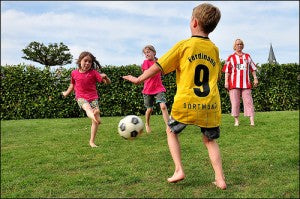 [/caption]
A sport helps in all aspects of children’s development. Character building, personality, physical and mental attributes can all be developed by indulging in a sport. Sports helps a child develop certain characteristics which nothing else can develop, such as loyalty, teamwork, ambition, sportsmanship and many more.
The most important characteristic, which can be developed by any type of game, is determination. Determination is one rare element; those who get it can achieve anything in the world. It gives a child a ‘never die’ attitude which eventually takes him/her to greater heights in life.
The following list will categorize different types of sports and their role in a child’s development.
* Football: It transforms a child into a mature grown person. Football helps develop a drive in the child, eventually leading to competiveness. This competitiveness in the game requires teamwork and sportsmanship which a kid develops as much as he plays. Football also helps increase stamina and awareness of a child. Some other aspects which football improves are mental and physical toughness and reflexes and reactions.
* Basketball:It has almost similar outcomes as football. Sportsmanship and competitiveness are improved by playing
[caption id="attachment_7874" align="alignright" width="279" caption="Photo by ICMA"]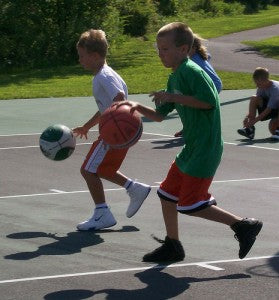 [/caption]
basketball. As for physical attributes, the child gets extremely good jumping ability and can have a good height. The game also helps improves awareness and reactions better than football.
* Golf: It helps develop a perfectionist. Golf is a game which allows a low margin of forgiveness for error. One has to be very sharp and precise about his/her shot. Golf does not help significantly in physical development, only arm muscles grow strong. As it is with most other games, it develops competitiveness in a child.
* Rugby: Transforms a child into a man. Rugby is the most physical sport there is. It does not help in increasing mental abilities significantly, but its influence in physical development is second to none. The physical toughness and growth of a rugby player is far better than other sportsmen.
* Cricket & Table-tennis: Cricket and table tennis are both reaction development sports. Both games require excellent reactions and reflexes. Both games have a small influence on the physical development; table tennis requires footwork and triceps whereas cricket requires speed and agility.
The amazing thing about sports is that one can learn a few important things about life without giving anything. It is a teacher who gives their students some great qualities for free. These teachings have been passed on for generations and millions of people have benefited from them.
Sometimes, a sportsman is lucky enough to find himself/herself leading their team. The pride and honor give a confidence boost like nothing else. It gives a sense of responsibility; the captain has to lead the team with example. He/she should have high motivational skills and an urge to make sure the team is going in the right direction. Leadership is a gift in sports; one who is lucky enough to be handed the role should definitely make the best of it.
Mike is a father of 2, interested in his children's development. Mike thinks that sport is a great component in his child education, but also believe that toys and especially educational toys play an important role.
In an average classroom, there are likely to be around five children who already wear glasses but there are also likely to
[caption id="attachment_7827" align="alignright" width="300" caption="Photo by Ernst Vikne"][/caption]
be just as many who should be wearing glasses who are not! There are a number of reasons for this and the most common include:
- Child does not want to wear glasses. Although less so nowadays, there is a certain stigma attached to wearing glasses which can result in children who wear them being teased. As a result of this, children may be fully aware that their vision is blurred but they choose to keep it to themselves to avoid having to wear glasses.
- Child is unaware of the need for glasses. This is especially the case if the child in question is under the age of 7 years old. Below this age, children are likely to assume that their vision is normal, as it is all they have ever known
As a teacher there are tell-tale signs that you can look out for that could indicate that one of your students may have a problem with their vision. If you notice any of the following symptoms on more than one occasion you should suggest to that child’s parents that they should attend for an eye examination:
- Squinting/screwing their eyes up. This is the most likely sign that you will encounter and typically indicates that a child is near sighted. Such students will have no problem reading or looking at the computer but will struggle to see that projector chart at the front of the class. Near sighted prescriptions generally get worse over time so it best for them to get an eye test as soon as possible.
- Poor concentration/lack of interest. If the student has very poor vision they may become disruptive in the classroom mainly as a result of boredom. It can be amazing to see the improvement in a child’s behaviour once they have their vision corrected with glasses.
- Child falling behind. Naturally in a classroom there will be children of all abilities but if you suspect a child is more capable than their results are suggesting, then it could possibly be a problem with their vision.
- Disinterest in sports. If a child has a lazy eye it is quite likely that they will have problems with their co-ordination. Such a child may find certain sports difficult, meaning they try to avoid playing them where possible.
- Headaches. Most children will complain of headaches from time to time but if this is happening frequently it
[caption id="attachment_7829" align="alignright" width="300" caption="Photo by Jesslee Cuizon"][/caption]
could mean the student in question may require glasses. Such children are more likely to be long sighted or have astigmatism and headaches are most likely to occur after reading or working on the computer. The headaches are likely to be located at the front or the side of the students head if they are related to their vision.
- A turn in your student’s eye is more likely to be noticed in a child under the age of 6 years old and is likely to indicate a lazy eye. Lazy eyes can only be treated up to the age of 7 years old so it is important that such a child in seen by the Optometrist as soon as possible.
If you ever suspect any of the above signs/symptoms, start by contacting the child’s parents to encourage them to take their child for an eye test. It is generally advisable for all children to get their eyes tested regardless of whether any problems are suspected as early eye tests reduce the risk of a child developing a lazy eye. Eye glasses are far more fashionable for children than they used to be and if the child is a little older they could consider contact lenses or laser eye surgery. However, laser eye surgery is generally only carried out on 18 years olds and over.
This article was provided by an Optometrist and guest writer, Tim Harwood, who regularly examines the eyes of children ranging from age 2 – 16 years old! He is a firm believer in getting children in for eye tests as early as possible to reduce the chances of a lazy eye developing. In addition to his Optometry practice he also writes articles for his own website,Treatmentsaver.com, which covers topics ranging from Botox prices to Glaucoma.
Communication skills have never been more important. Children who are comfortable with both written and oral 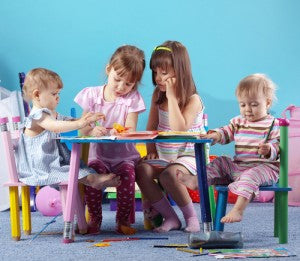 communication have a natural leg up when they start school and that gap only widens through the college years and beyond. Parents can and should help nurture their child’s communication skills from birth onwards to give them the widest range of options in later life.
Here are a few ways that parents can help their children build their verbal abilities and self confidence.
Pretend Play
Playing pretend or make believe is a wonderful way for parents to nurture their child’s imagination while at the same time exercising their ability to tell stories, give and follow directions and explore how people in different roles communicate with each other (parent to parent, teacher to student, boss to employee, and so on).
Encourage your child’s pretend play by providing them with props to support their make-believe worlds. Some good choices are toy kitchen equipment, wooden tools and tool bench, dolls and doll furniture, costumes, puppets and toy animals of every kind. Give them a space that’s all their own where they can be free to let their imagination roam.
Do allow your child to direct the storyline. You can ask them questions to help stretch or challenge their verbal abilities as you play together. Avoid simple yes/no questions and probe into the hows and whys of what is going on in your game.
Strengthen Fine Motor Skills
In many school systems these days, children are expected to go into kindergarten already able to write all of the letters of the alphabet. Children with weak or undeveloped fine motor skills often find themselves losing confidence and falling behind as they struggle to learn to write. Being able to write easily helps children as they move on to composing their own sentences and other written communication. A late start with handwriting can cripple a child’s progress for years to come.
The good news is that you don’t have to spend hours forcing your preschoolers to practice writing to strengthen their fine motor skills and hand-eye coordination. Some fun activities that use both of these skills include:
- Stringing beads
- Wooden puzzles
- Using activity dolls or boards with buckles, laces, buttons and snaps
- Playing with clay or play dough
- Making music with toy instruments
- Other arts and crafts
Help your child develop the fine motor skills he or she will need to move on to writing so that they can have the confidence and skills that they’ll need to when it comes time to start more advanced work in reading and composition.
Play Games together as a Family
For a child, spending time with their parents and older siblings isn’t just a treat, it’s also an opportunity for them to stretch their verbal and social abilities. Playing board games, cards or doing puzzles as a family is a great way to strengthen family bonds while at the same time helping your child develop more mature communication skills.
Family game nights help children learn the basics of social interactions such as taking turns, cooperation and how to be a good winner or loser. There are even many games available that have a strong focus on on building verbal ability and learning how to communicate with a partner or in a group.
You can even take advantage of time together in the car or at the dinner table to play conversation starter or trivia games, for example the Box Girls sets. These kinds of games help families break the ice and learn more about each other. These games help children learn how to start conversations and how to take turns listening and sharing.
By: Jacob and Carol Maslow.
Jacob and Carol Maslow are proud parents of five pre-teen children. Jacob works for a site that sells the full line of Melissa and Doug Classic Toys and believes real toys don't need batteries. Carol is a certified therapist and specializes in Early Intervention, helping developmentally delayed children integrate. Carol uses the wooden toys from Melissa and Doug as teaching aids.


