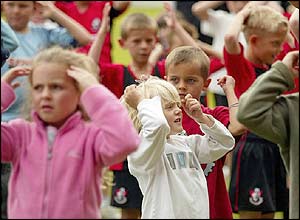
 Most children need at least an hour of physical activity every day to help with the proper development of their growing bodies. The good news is that the required physical activity can be achieved through any number of exciting, interesting and engaging physical activities.
The Centers for Disease Control in Atlanta recommends that children engage in three different kinds of physical activity each day: aerobic, muscle strengthening and bone strengthening activities. All three types of exercise are required for proper growth, development, and weight management. The CDC offers specific guidelines governing how much of each kind of exercise a child should engage in each week to help parents determine whether their kids are getting enough physical exercise.
If you have any concerns about the safety of an exercise for your child, or if exercises need to be modified or tempered to accommodate another physical condition, talk to your child's doctor first. Your child's doctor may advise you to seek out a consultation with a physical therapist to ensure that your child's exercise doesn't dangerously aggravate an underlying medical condition.
Aerobic Exercises
Aerobic exercises are those that require the use of a lot of oxygen. Aerobic exercises also elevate the heart rate. Aerobic exercises are important because they provide both the good cardiac workout and physical care we need each day to remain healthy. Examples of aerobic exercise would be walking and running. Both children and adults walk quite a bit each day, but regular walking doesn't really count as aerobic exercise.
Exercise quality walking involves moving at a specific (rapid) pace and elevating your heart rate while doing it. A rapid walking pace is effectively the pace you'd use to catch a bus or move quickly from classroom to classroom, without actually running. Other activities that include a significant amount of running or moving, like playing soccer or baseball, fall into this category. The CDC recommends that about 60% of a child's physical activity each week come from aerobic exercises.
Muscle Strengthening
The second kind of activity the CDC recommends for children on a weekly basis includes those exercises or activities that strengthen muscles. Exercises like bicycle riding, gymnastics and swimming are examples of those that primarily strengthen the muscles. Children can engage in weightlifting to strengthen muscles, but younger children typically don't find this kind of exercise appealing. Good muscle strength is needed to complement the development of strong bones. It also helps in weight management.The CDC recommends that 20% of the exercise activities a child engages in each week should be directed toward improving muscle strength.
Bone-Strengthening Exercises
The third kind of physical activity the CDC recommends for children on a weekly basis is bone-strengthening exercises. These exercises engage the skeletal muscles, generally the largest muscles in the body. Any kind of exercise that uses the large muscles in the legs and arms falls into this category, including some exercises that have already been mentioned. Activities that involve running, swimming, climbing, and bike riding will all provide good bone-strengthening activities for children.
Generally, any exercise that requires exertion will help strengthen a child's bones. It's important to remember that a child's bones are "soft" when compared to an adult's bones, so strenuous physical exercise that results in injury can sometimes affect the child's bones and his or her growth. If your child experiences an exercise-related injury like a twisted ankle, groin pull or broken bone, your doctor will advise you on the best recovery techniques as well as any physical therapy that may be required to fully recover.
David Taylor is an online freelancer who tends to focus his writing on topics related to college health education programs like physical therapy assistant programs and schools.
In an average classroom, there are likely to be around five children who already wear glasses but there are also likely to
[caption id="attachment_7827" align="alignright" width="300" caption="Photo by Ernst Vikne"][/caption]
be just as many who should be wearing glasses who are not! There are a number of reasons for this and the most common include:
- Child does not want to wear glasses. Although less so nowadays, there is a certain stigma attached to wearing glasses which can result in children who wear them being teased. As a result of this, children may be fully aware that their vision is blurred but they choose to keep it to themselves to avoid having to wear glasses.
- Child is unaware of the need for glasses. This is especially the case if the child in question is under the age of 7 years old. Below this age, children are likely to assume that their vision is normal, as it is all they have ever known
As a teacher there are tell-tale signs that you can look out for that could indicate that one of your students may have a problem with their vision. If you notice any of the following symptoms on more than one occasion you should suggest to that child’s parents that they should attend for an eye examination:
- Squinting/screwing their eyes up. This is the most likely sign that you will encounter and typically indicates that a child is near sighted. Such students will have no problem reading or looking at the computer but will struggle to see that projector chart at the front of the class. Near sighted prescriptions generally get worse over time so it best for them to get an eye test as soon as possible.
- Poor concentration/lack of interest. If the student has very poor vision they may become disruptive in the classroom mainly as a result of boredom. It can be amazing to see the improvement in a child’s behaviour once they have their vision corrected with glasses.
- Child falling behind. Naturally in a classroom there will be children of all abilities but if you suspect a child is more capable than their results are suggesting, then it could possibly be a problem with their vision.
- Disinterest in sports. If a child has a lazy eye it is quite likely that they will have problems with their co-ordination. Such a child may find certain sports difficult, meaning they try to avoid playing them where possible.
- Headaches. Most children will complain of headaches from time to time but if this is happening frequently it
[caption id="attachment_7829" align="alignright" width="300" caption="Photo by Jesslee Cuizon"][/caption]
could mean the student in question may require glasses. Such children are more likely to be long sighted or have astigmatism and headaches are most likely to occur after reading or working on the computer. The headaches are likely to be located at the front or the side of the students head if they are related to their vision.
- A turn in your student’s eye is more likely to be noticed in a child under the age of 6 years old and is likely to indicate a lazy eye. Lazy eyes can only be treated up to the age of 7 years old so it is important that such a child in seen by the Optometrist as soon as possible.
If you ever suspect any of the above signs/symptoms, start by contacting the child’s parents to encourage them to take their child for an eye test. It is generally advisable for all children to get their eyes tested regardless of whether any problems are suspected as early eye tests reduce the risk of a child developing a lazy eye. Eye glasses are far more fashionable for children than they used to be and if the child is a little older they could consider contact lenses or laser eye surgery. However, laser eye surgery is generally only carried out on 18 years olds and over.
This article was provided by an Optometrist and guest writer, Tim Harwood, who regularly examines the eyes of children ranging from age 2 – 16 years old! He is a firm believer in getting children in for eye tests as early as possible to reduce the chances of a lazy eye developing. In addition to his Optometry practice he also writes articles for his own website,Treatmentsaver.com, which covers topics ranging from Botox prices to Glaucoma.
