With the invention of the Wii and Xbox, many children spend their time indoors playing computer games. Why not encourage your children to get outside with my guide to children's games from around the world.
Agawang Sulok
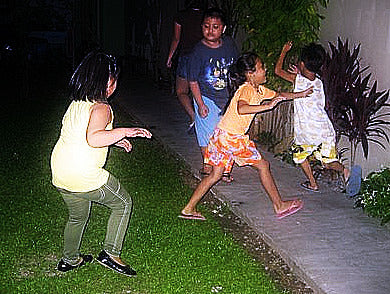
Agawang Sulok Image Source
Agawang Sulok is a traditional Filipino children's game and literally translated means catch and own a corner. One child is 'it' and four other children each have a corner. The aim of the game is for the children to switch corners without the child who is 'it' getting their first. If they do, then the child without a corner is then 'it'.
Stalking the Drum
Stalking the Drum Image Source
Stalking the drum is a traditional Native American game to increase spatial awareness. All participants are blindfolded except one who beats a drum. This starts off as a loud, deep bang and fades to a soft, quiet bang. The blindfolded children must follow the noise and find where it is coming from.
Sardines
Sardines Image Source
Sardines is a great game and doesn't necessarily need to play outside. A variant of hide and seek, one person goes to hide and one person is the finder. The remaining players have to find the person hiding and then join them before the finder finds them. Rather funny when you get more than a couple of people trying to squeeze into a small space.
Kappa Gantulu
Kappa Gantulu Image Credit
Kappa Gantulu is the Indian version of stone skimming. You need a lake, pond or flat body of water and some flat-bottomed stones. Throw the stones onto the water and watch it bounce over the surface. The player with the most bounces is the winner. Research has shown that an angle of about 20 degrees between the stone and the water is best.
British Bulldog
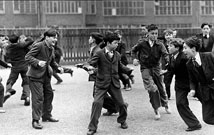
British Bulldog Image Credit
British Bulldog, also known as Red Rover or Cocky Laura, is survival of the fittest. One or two players stand in the middle of the playing area and are the "bulldogs". The remaining players then have to run from one side to the other without being caught. Those who are caught become bulldogs and the winner is the last player standing.
Chinese Jump Rope
Chinese Jump Rope Image Source
Chinese jump rope is a Chinese game similar to the western game of hopscotch. Two children stand facing each other with a circle of rope or elastic about 5 to 6 feet in length, pulled taught around their ankles. The other players then have to do a series of moves without stopping or hesitating. As the game progresses the rope gets higher therefore increasing the difficulty.
Ro, Cham, Beau
Ro, Cham, Beau Image Source
Versions of the game Rock, Paper, Scissors or Ro, Cham, Beau date back to the Chinese Han Dynasty. The game requires two players and is normally played in a best of three matches. While saying rock, paper, scissors, the two players bounce their fists up and down and then make the sign for rock, paper or scissors with their hands. Rock beats scissors, scissors beat paper and paper beats rock. This game is often used to settle disagreements.
Declan Ruki
Declan Ruki Image Source
Declan Ruki is similar to Simon Says. One player becomes Simon and tells the other players what to do, such Simon says put your hands on your head. The trick is you should only do something if it preceded by Simon says. If you do what they say and they have not said this, then you are out. This is a popular children's party game and the winner is only remaining player.
This fun and playful editorial was created on behalf of Hotelclub.com; where you can find family friendly hotels in Macau.
Communication skills have never been more important. Children who are comfortable with both written and oral 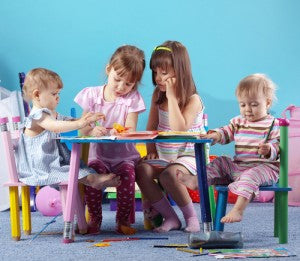 communication have a natural leg up when they start school and that gap only widens through the college years and beyond. Parents can and should help nurture their child’s communication skills from birth onwards to give them the widest range of options in later life.
Here are a few ways that parents can help their children build their verbal abilities and self confidence.
Pretend Play
Playing pretend or make believe is a wonderful way for parents to nurture their child’s imagination while at the same time exercising their ability to tell stories, give and follow directions and explore how people in different roles communicate with each other (parent to parent, teacher to student, boss to employee, and so on).
Encourage your child’s pretend play by providing them with props to support their make-believe worlds. Some good choices are toy kitchen equipment, wooden tools and tool bench, dolls and doll furniture, costumes, puppets and toy animals of every kind. Give them a space that’s all their own where they can be free to let their imagination roam.
Do allow your child to direct the storyline. You can ask them questions to help stretch or challenge their verbal abilities as you play together. Avoid simple yes/no questions and probe into the hows and whys of what is going on in your game.
Strengthen Fine Motor Skills
In many school systems these days, children are expected to go into kindergarten already able to write all of the letters of the alphabet. Children with weak or undeveloped fine motor skills often find themselves losing confidence and falling behind as they struggle to learn to write. Being able to write easily helps children as they move on to composing their own sentences and other written communication. A late start with handwriting can cripple a child’s progress for years to come.
The good news is that you don’t have to spend hours forcing your preschoolers to practice writing to strengthen their fine motor skills and hand-eye coordination. Some fun activities that use both of these skills include:
- Stringing beads
- Wooden puzzles
- Using activity dolls or boards with buckles, laces, buttons and snaps
- Playing with clay or play dough
- Making music with toy instruments
- Other arts and crafts
Help your child develop the fine motor skills he or she will need to move on to writing so that they can have the confidence and skills that they’ll need to when it comes time to start more advanced work in reading and composition.
Play Games together as a Family
For a child, spending time with their parents and older siblings isn’t just a treat, it’s also an opportunity for them to stretch their verbal and social abilities. Playing board games, cards or doing puzzles as a family is a great way to strengthen family bonds while at the same time helping your child develop more mature communication skills.
Family game nights help children learn the basics of social interactions such as taking turns, cooperation and how to be a good winner or loser. There are even many games available that have a strong focus on on building verbal ability and learning how to communicate with a partner or in a group.
You can even take advantage of time together in the car or at the dinner table to play conversation starter or trivia games, for example the Box Girls sets. These kinds of games help families break the ice and learn more about each other. These games help children learn how to start conversations and how to take turns listening and sharing.
By: Jacob and Carol Maslow.
Jacob and Carol Maslow are proud parents of five pre-teen children. Jacob works for a site that sells the full line of Melissa and Doug Classic Toys and believes real toys don't need batteries. Carol is a certified therapist and specializes in Early Intervention, helping developmentally delayed children integrate. Carol uses the wooden toys from Melissa and Doug as teaching aids.
Use the last couple of weeks before break to review important skills with some fun Christmas-themed games and activities. I've included by Top 4 Ways to use these Christmas games and activities in your classroom!
Here's a reference list for quick and easy lesson plan ideas this week!
Take a peak under each heading for free lesson plans and printable templates.
Language Arts & Writers' Workshop:
Math:
- Scarecrow Math - Free printable. All elementary grades can enjoy this lesson. Teaches addition, subtraction, multiplication and division.
- Pumpkin Patrol Math - You'll need a pumpkin for this one.
Science:
Crafts:
Poems & Songs
Online Games for the Computer Lab:
More Surprises This Week:
We add more each week, so be sure to bookmark this page and check back soon.
Here's a Rainy Day Game. Create the game now, so it's all ready to go on rainy days. Choose any point system you want. If your students are learning to count by 2's, 3's or 10's, this game can help them learn to quickly add points.

