
Teacher Resources
Five Ways to Reflect on Thanksgiving November 05 2010, 0 Comments
This isn't your typical reflection lesson plan! These five free lesson plans cover how to teach mirror and reflection in math, science, art and writing.Pattern Block Turkey Math Lesson Plan November 03 2010, 0 Comments
According to this free Thanksgiving-themed lesson plan, it's hip to be square (or triangular, or rhomboid...).
These Pattern Block Turkeys are a fun way to work on important math skills with kids at a variety of ages. Appropriate for a whole group or small group math lesson, this activity is also a great addition to a math learning center with pattern block activities.
Since Thanksgiving is coming up, these Pattern Block Turkeys also make an excellent combination of math practice with artistic expression. Once your lesson is done, have your kids take them home to help decorate for the Thanksgiving holiday!
Practice with Patterns and More
These turkeys are ideal for introducing or reviewing geometry vocabulary and shape identification. The pattern blocks used in this lesson plan include hexagons, trapezoids, triangles, rhombuses, parallelograms and squares. The shapes are also color-coordinated, which helps students identify and remember the names of specific shapes.
The turkey pictured above was created using a symmetrical pattern, which would also be a good concept to introduce or review during this activity. Students could be required to create symmetrical turkeys or encouraged to create asymmetrical works of art depending on the kids in your class.
Creative Turkeys
While creativity is one goal of this project, each Pattern Block Turkey must begin with a central hexagon in the middle of the background paper. If you want larger and more elaborate turkeys, bigger background sheets are required. The background sheet in this case was a half-sheet. The pattern blocks were white photocopies from math curriculum, which can actually help your students with identifying them through quickly and correctly coloring them using crayons.
Aside from using the hexagon in the center as the turkey's body, the rest of the turkey is up to each student's preference! I encourage students to explore different patterns using the shapes, and refrain from gluing anything down on the background paper until they've made final decisions about their designs. These magnetic pattern blocks can also help kids plan out their creative turkey designs.
Display the Variety of Patterns
Once students are finished gluing their pattern block pieces, provide them with googly eyes and other art materials to help them make creative turkey faces.
Display the turkeys with this Pattern Block Turkey Page, using one half for each student. For each turkey, students must count up the amount of each shape, including hexagons, trapezoids, squares, triangles, parallelograms and rhombuses. I also included a phrase regarding the symmetry of the turkey at the bottom of each half-sheet.
Use these creative turkeys as a classroom or hallway bulletin board before sending them home with your students for a festive Thanksgiving decoration!
Celebrate Fall in the Classroom with Trees! November 02 2010, 0 Comments
The beauty of Autumn is in full-swing. Take time with the students in your classroom to study and appreciate all that this season has to offer starting with this lovely poem about trees.November Bulletin Board Ideas and Giveaway! November 01 2010, 5 Comments
Gorgeous fall leaves can be incorporated into your curriculum in a variety of ways. Here are a few ideas - add your own and be entered into this week's giveaway!Create a Word Graveyard to Teach Synonyms October 25 2010, 0 Comments
This spooky Halloween activity will help your students banish overused words from your classroom while learning how to use a thesaurus.A Classroom Apple Party October 20 2010, 0 Comments
The letter A deserves a party! Celebrate the letter A with a series of apple-themed activities that are ready for the different learning centers in your classroom.Celebrate Your Students With Cheers! September 17 2010, 0 Comments
Cheers in the classroom show appreciation for students' work and teach them how to encourage each other. This wide variety of cheers will help add fun to any lesson plan.Phonemic Awareness Songs and Rhymes September 10 2010, 0 Comments
Phonemic Awareness is an important element in a primary classroom's curriculum. Use these fun activities and games to teach or review these skills in your classroom!Rainforest Lesson Plan and Wikki Stix Animals February 22 2010, 1 Comment
Your students will love creating their own rainforest, rainforest animal and rainforest report. This habitat lesson comes with a free rainforest layer printable template. You'll also find a free, printable rainforest report book.
Materials:
- free rainforest layer template, tree & animal faces template (black & white or color) For the example, the teacher can use the color template. Students can color the black and white template.
- free rainforest report book template
- wikki stix (choose the colors you want for the animals)
- construction paper (green & blue)
- shoe box
- tape
- glue
Instructions:
- Set the shoebox sideways and put the lid on its side.
- Glue or tape the rainforest layer template inside of the shoebox.
- Glue or tape green construction paper on the inside of the lid and inside of the shoebox to make the forest floor.
- Cut blue construction paper and glue it to the forest floor to make a stream.
- Color and cut out the tree and leaves. Roll the tree trunk into a cylinder shape. Cut several slits on the bottom and top of the tree trunk. Tape the leaves onto the top (branches) and tape the trunk to the forest floor.
- Use wikki stix to design a rainforest animal.
Ways to Use Wikki Stix to Create Animals:
- Twist - With at least 2 wikki stix, twist the pieces together. (You can see this technique used for the puma.)
- Roll - Roll the wikki stix in a circular motion, as if making a cinnamon roll. (You can see this technique used for the orangutan.)
- Fold - Fold the wikki stix back and forth several times. You can layer colors, if you wish. (You can see this technique used for the toucan's beak and wings.)
- Ball - Roll the wikki stix into a ball, like a ball of yarn. (You can see this technique used for the toucan's body.)
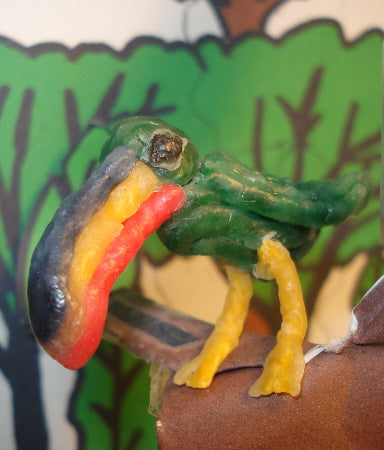
Rainforest Animal Faces:
You can make the animals' faces using any of the following techniques.
- Free Face Shape Template See page 2 or create your own.
- Cut very tiny pieces of the wikki stix to make the faces. For the eyes cut out two pieces of white. Roll into a ball. Cut out any other color for the inside of the eye, but slightly smaller than the white pieces. Press the colored pieces into the larger white ball and push it onto the face. You could use any color to create a mouth or beak.
- Press wiggly eyes onto the face or glue them onto the Free Face Shape Template
Rainforest Report
Students conduct research in order to learn more about their animals. Visiting the school library, supervised internet research and encyclopedias are all excellent resources for research.
Materials:
- Rainforest Report Book
- Story Web (Add more lines, if needed.)
Students can answer the following questions in their report:
- Name- What is the scientific name of the animal?
- Anatomy - Explain the anatomy of the animal. What does it look like?
- Locomotion - How does the animal move?
- Diet - Is the animal an herbivore, carnivore or omnivore? How does the animal get food? Where is the animal in a food web?
- Habitat and Range- What country does your animal live in? Where in the rainforest does the animal prefer to be? Does the animal prefer the forest floor, understory layer, canopy layer or emergent layer of the forest?
- Adaptations- When you look at the animal do you see something unique that helps it live well in the environment? For example, the orangutan has very strong and long arms. Why do you think the orangutan's arms are so strong.
- Life Cycle - How does the animal give birth to her young? What is the life cycle like?
- Survival- Does the animal have any enemies? If so, what does the animal do to protect himself? Is this animal endangered? How many are alive today? What can we do to prevent the animal's extinction?
- Page 1 of 2
- Next