Grades: K-2nd
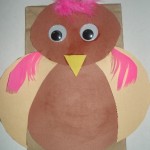 During the Fall, when I taught 2nd grade, my students studied mammals & birds. My students took a field trip to the pumpkin patch farm. During this trip they learned about many types of animals, including owls. This can be a fun craft to suppliment what you are already teaching the students about birds.
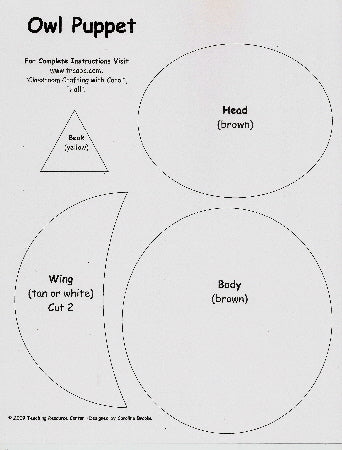 Materials:
- Free "Owl Puppet" Template
- Construction paper (brown, yellow, tan or white)
- Feather (optional, 1 per child, any matching color)
- Paper bag (1 per child)
- Scissors
- Glue
- Wiggle eyes (2 per child)
Instructions:
Teacher
- Print the template onto cardstock.
- Cut out the template.
- Trace onto the construction paper.
Students
- Cut out the head, body, wings and beak.
- Glue the head onto the bottom of the paper bag.
- Glue the body onto the front of the paper bag.
- Glue the wings under the head (on the bottom of the paper bag, so when you open and close the bag the wings will flap).
- Glue the beak towards the bottom of the head.
- Glue on the wiggle eyes.
- Glue a feather on top of the head (optional).
Materials:
- Free, printable "Bat Craft" template (If possible, print it directly onto card stock to speed up the process.)
- Scissors
- Black (body, wings, head, ears) & yellow construction paper (eyes)
- White pencil or crayon
- Glue
Instructions:
Teacher (or Parent Volunteer)
- Trace the template onto construction paper. One bat for each student.
Students
- Cut out the bat parts.
- Glue the wings, head and ears onto the body.
- Glue on the yellow eyes.
- Use a white crayon or pencil to make a nose and mouth.
- Write your name on the back.
Lesson Plan
During the Fall, I took my 2nd grade class to the pumpkin patch & farm. We also studied mammals. This included a study about bats. This interesting article can give you a quick brush up on bat facts. If you can put your computer screen on a TV monitor it can be helpful to show the animation of the bat echo locating, which is described in this article.
"This is the basic principle of echolocation. Bats make sounds the same way we do, by moving air past their vibrating vocal chords. Some bats emit the sounds from their mouth, which they hold open as they fly. Others emit sound through their nose. It's not fully understood how the bat's sound production works, but scientists believe that the strange nose structure found in some bats serves to focus the noise for more accurate pin-pointing of insects and other prey."
(9/16/09, How Stuff Works, http://animals.howstuffworks.com/mammals/bat2.htm)
Experimenting with Echolocation
Give each student a paper cup and ask him/her to talk into the cup. (To prevent annoying the teacher this echo experiment needs to last about 1 min. or less, just long enough to hear and feel the echo bouncing back from the cup -or- just have one student demonstrate the process for the class.)
Can he/she hear or feel the echo?
Imagine that the cup was really a canyon and you were yelling across the canyon.
"The bat's brain processes the returning information the same way we processed our shouting sound using a stopwatch and calculator. By determining how long it takes a noise to return, the bat's brain figures out how far away an object is."
(The precise mathematical formula is in the article, but for younger students this will be too much information, so I took it out of the lesson plan.)
"A bat processes all of this information unconsciously, the same way we process the visual and aural information we gather with our eyes and ears. A bat forms an echolocation image in its head that is something like the image you form in your head based on visual information. Bats also process visual information -- contrary to popular belief, most bats have fairly acute vision. They use echolocation in conjunction with vision, not instead of it."
(9/16/09, How Stuff Works, http://animals.howstuffworks.com/mammals/bat2.htm)
Students can use the passes to use the restroom or for traveling through the classroom halls.
Directions:
1. Make two copies of this sheet. (For safety, students can use the buddy system, which is explained below.)
2. Color each pass.
3. Cut out each pass.
4. Laminate each pass.
5. Punch a hole at the top of each pass.
6. Put strings through the holes.
7. Hang the passes by the door.
8. Explain the buddy system to the students.
While teaching kindergarten and 2nd grade, my students were taught to use the buddy system. When a student left the room he/she always left with a buddy.
Hall & Restroom Health & Safety Rules:
Here's a helpful check list to review with the students.
1. Be sure to walk.
2. Stay with your buddy.
3. Never leave campus with any adult without checking with your teacher first.
4. If someone (even an adult) talks to you in the halls and you feel uncomfortable, go directly to the classroom and tell your teacher.
5. Wash your hands with soap and water after using the bathroom.
6. Use a paper towel to open the bathroom door and throw it in the garbage.
Why Family Trees are Important
[caption id="attachment_1771" align="alignright" width="250" caption="Download this free family tree template and have your kids decorate it with family photos!"][/caption]
It's important to really know where our students are coming from. When we take the time to get to know our students they know that we care for them. When they feel cared for, they feel safe and this is the ideal environment for learning.
Seeing a child's family tree can help us really understand the child's history. While teaching, sensitive issues can come up and if we understand the world of the child we are better able to protect the child from painful circumstances.
For example, if during a bike safety orientation you noticed that Katie looked sad, you may just think she was having a bad day. However, if at the beginning of the year you had sent home the family tree craft you would learn that her mother was killed by a wreck-less driver while biking.
So, before the orientation you would know that it would help Katie feel supported and cared for if you sat next to her. We may learn some information from previous teachers, but there may be more information we can find out to help the student. Many teachers don't view teaching as just teaching academics, we truly have the opportunity to help children through achievements and the difficult circumstances of life.
Family Tree Sensitivity & Confidentiality
This is an assignment I'd recommend we keep confidential. I also recommend not grading it. We have the opportunity to find out valuable information that will help us better understand and help the child and his/her family. Putting the family tree inside the child's confidential file (in a locked file cabinet) and later putting the family tree inside the end of the year Memory Book (which I first discussed in the Star Student Bulletin Board article), is a way for the child to look back and remember how he/she felt supported and understood by his/her classroom teacher.
It's also important to keep the child's family information strictly confidential and not discuss it with teachers, other parents or students. Even if we feel like we need to de-stress or the person needs to know, it's not a good idea to discuss this information. We were trusted with confidential information for the purpose of helping the child. Most of the time, telling anyone else won't do them any good and may end up hurting the child or parent because their trust was broken.
When I worked as a school counselor (before I was a kindergarten & 2nd grade teacher) I knew how to keep confidentiality really well. Over the years, I've found that some teachers can do this and others aren't so hot at it. When we hear talk in the teachers' lounge it's a good idea to just walk away. Doing this can keep our conscious clear and out of trouble. We've got too much to do anyway.
Parent/Teacher Conferences
During parent/teacher conferences I found that it was helpful to keep the family tree in the student's file. Before the meeting, I reviewed the family tree. Doing this helped me remember how the family may have been feeling. This helped me feel more prepared between meetings. I was able to clear my mind and remember the details concerning the next family before they walked in the door.
Homework
This is a project that would work well for homework because sensitive issue may/or may not be brought up. Some families enjoy this project and want to share it with everyone. They may not feel really sensitive about anything at all. Others enjoy it, even though it may bring up sensitive issues and find that it's a healing and bonding experience with their child. Some don't enjoy it, but complete it anyway.
There's always a possibility that you won't get it back. I do not recommend marking the child's grade down if you don't get it back. I'd just use it as an indicator that there may be some pain there or there's just too much going on right now to deal with it.
A Family Tree is Kind of Like Thanksgiving
Alright, we all know that some people love the holidays and just can't wait until Thanksgiving dinner. Others dread it like the plague. The family tree can be like that. Maybe during 2nd grade Joey loved making his family tree, but after his uncle died during 3rd grade he didn't enjoy it.
Just like the holidays, family trees bring up family stuff. It's best if we know what's going on, so we know how to help the kids.
Materials:
- Free "Family Tree" Craft Template
- Family Tree Leaves (glue photographs or illustrations of family members inside the leaves.)
- Scissors
- Glue
- Crayons
- Photographs (Of family members cut into circles. Some people include pets.)
Directions:
Create a short note to parents and send the project home for homework. I'd encourage the children to ask their parents for photographs, but if they aren't able to get a photograph the student can draw a picture of the family member.
- Color the background blue.
- Draw grass and/or flowers.
- Color the tree brown.
- Color & cut out the leaves.
- Glue the photographs inside the leaves and label them (e.g. "Grandma").
- Glue the leaves onto the tree. The child can be placed in the middle of the tree and the family is on the branches.
- Ask the parent(s) to write a short note letting you know of any "Notes About Our Family". You may choose to have them put the notes inside a sealed envelope which will be turned in with the family tree in a manila envelope. It may be helpful to read these confidential notes and shred them afterwards. That way you know they remain confidential.
Tree Template Alternative Craft Ideas:
The template can also be used to create a couple of other crafts.
- Autumn Tree - Use the template to create a tree full of green, orange, yellow and red leaves. You can use this craft to compliment a lesson on photosynthesis.
- Spring Cherry Blossom Tree - Trace the tree template onto brown construction paper. Glue onto blue construction paper. Create cherry blossoms using squares of pink & white tissue paper. This is perfect for kindergarten or 1st grade.
Here's a free Back-to-School News activity.

