[caption id="attachment_1499" align="alignright" width="249" caption="Doing math with dolphins makes this learning activity a LOT more fun for your kids!"]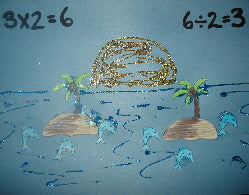 [/caption]
Each Dolphin Multiplication & Division craft represents a multiplication & division problem.
Dividing the dolphins swimming around each island solves the division problem.
Multiplying the dolphins swimming around each island solves the multiplication problem.
Materials:
Directions:
- Decide what the numbers will be. (e.g. 3 x 2 = 6 and 6 ÷ 2 = 3)
- Color & cut out the dolphins and islands to make the problem.
- Glue the dolphins swimming around the islands to create the problem.
(e.g. 2 islands, 6 dolphins, 3 dolphins swimming around each island.)
- Write the numbers showing the problems underneath the picture showing the problems.
(e.g. 3 x 2 = 6 and 6 ÷ 2 = 3)
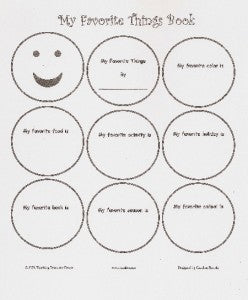
Students will love creating and reading the My Favorite Things book. Appropriate for K-2 grades.
Materials:
Directions for Students:
- Cut out the My Favorite Things template.
- Staple the book together.
- Color the cover of the book.
- Write words and draw pictures to complete the sentences on each page.
- Read your book to your family and friends.
A Fun Retro Craft Project for Class or Home
Why is it "smart"? The Smart Cootie Catcher can be used as a classroom instruction tool to help teach kids about coins and counting money!
We all know about the cootie catchers that got us into trouble while we were in school.
Teachers, let's put a twist on this cootie catcher and we can keep the students interested in learning.
Here's the free Smart Cootie Catcher template.
Smart Cootie Catcher Project Overview
Step #1 - Make the cootie catcher using the free down loadable template.
Step #2 - You can use the Smart Cootie Catcher to teach the students about money.
Materials
- Smart Cootie Catcher template (1 per student)
- pencils (1 per student)
- coins (penny, nickel, dime & quarter). If you separate your students into groups of four, you can give one set of the coins to each group.
- Money trivia questions or word problems. Tip - Write a list of questions on the board from the practice quiz from the chapter you are working on right now. Let the students choose the questions they would like to write inside.
Instructions for the "Coin Cootie Catcher"
- Emboss coins onto the front flaps and label each coin. (It works really well to roll up a wikki stix, like a cinnamon roll, and stick it to the back of the coin to keep in place while embossing it onto the paper.)
- Write values inside the cootie catcher, instead of just writing numbers. (e.g. 10 cents, 25 cents, etc.)
- Write questions under the numbers. You can write money trivia questions and answers on the board. The students can choose what they want to write inside their own cootie catcher.
To Play the "Coin Cootie Catcher" Game:
- Student #1 chooses a coin.
- Student #2 (holding the cootie catcher) spells the coin while opening and closing the cootie catcher.
- Student #1 chooses a coin value inside the cootie catcher.
- Student #2 counts the total amount.
- Repeat steps 3 and 4.
- Student # 1 chooses a value inside the cootie catcher.
- Student #2 opens the flap & asks the question.
- Student #1 answers the question.
- Student #2 gives the correct answer.
Check back soon for more instructional uses for the Smart Cootie Catcher.
Here's a Rainy Day Game. Create the game now, so it's all ready to go on rainy days. Choose any point system you want. If your students are learning to count by 2's, 3's or 10's, this game can help them learn to quickly add points.
Daily Journal Morning Routine
Every morning my students loved to write in their journals. The students enjoyed referring to the word wall as they wrote, but I encouraged my students to just write. Being concerned about spelling in their morning journals could block their writing ideas. (During Writers' Workshop, we focused on grammar and spelling.) The students were free to share their thoughts each morning, and they enjoyed the self expression. I encouraged the students to fill one page with writing and to make one illustration.
Finished Journals
I loved to get a finished journal on my desk. I'd read through the journal and write positive comments. I never corrected the grammar or spelling in these journals. I just wanted to hear what my students had to say. I'd stamp the last page and write a nice note. The students loved reading my comments. It helped me really see what was going on in their lives.
- Cover - Copy one for each student and fold in half. (The lined pages, below, are stapled inside).
- Lined Pages - Create as many pages as you wish. You can make the journals double sided, or leave the back side blank for illustrations. In that case, one page will have lines and the other will be a blank page for an illustration.
- Schedule about 15 minutes every morning for journal writing.
-or-
Free Back-to-School "Star Student" bulletin board. Teaching good character & self-esteem is just as important as academics. When we teach, we are looking into the eyes of the future. Our students can learn to share their gifts and talents with the world while making a positive difference. It's amazing that they can learn this skill from us!
Lakota history teaches children to care for nature, listen to their dreams and make wise choices. Children will love creating dream catchers to hang above their beds.
This lesson plan is all ready to go! Just read aloud the history & culture and order Wikki Stix. The students will bring a yogurt lid from home.
Each Starry Night craft represents a subtraction problem. Subtracting the stars underneath the clouds solves the subtraction problem.
Here's a free Back-to-School News activity.
Each student will make a unique Addition Ladybug. Adding the dots on each wing solves the addition problem. This craft comes with a free template.
