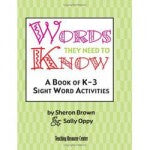
A TRC Original, Words They Need To Know: A Book of K-3 Sight Word Activities by Sheron Brown and Sally Oppy, is intended for use by primary teachers, reading specialists, and classroom volunteers. This professional resource is easy to use, addressing the management of sight word activities and materials, as well as how to fit sight word activities into a busy instructional day.
The Contents also contains the basic philosophy of why we teach sight words in the classroom: Recognition leads to greater fluency, speed and comprehension in early readers. Using this resource in your classroom will enable your K-3 students to learn the first 300 essential sight words of the American Heritage List of 1,000 most frequently used words in written English.
When it comes to building students' knowledge and skills, assessment is a necessary requirement. Words They Need To Know: A Book of K-3 Sight Word Activities begins with a breakdown by grade level of sight word lists for ongoing assessment as students progress, including suggestions about how to give the sight word assessments. These instructions are clear and easy to follow, appropriate for the teacher, classroom aides or parent volunteers.
After assessment comes practice, and this resource contains a large variety of activities for use in literacy centers, at students' desks or one-on-one with an adult. These activities are broken down into Word Card, Magnetic Letter and Writing Activities. Along with the Literacy Learning Center cards with instructions, there are ready-to-duplicate flashcards, assessment tools, record keeping pages, and gameboards.
The activities in Words They Need To Know: A Book of K-3 Sight Word Activities will help students practice the 300 essential sightwords individually, in partners, or in small group settings, providing fun ways for students to become better readers!
![tangram-alphabet[1]](../../../s/files/1/0255/7841/t/1/assets/blog_tangram-alphabet1-150x150_1427.jpg "tangram-alphabet[1]")
Tangram Alphabet: Building Letters With Tangrams is a deceptively simple conceptual resource for teachers. It's a quick read, and all the more valuable for the possibilities it offers students across the curriculum.
If you've not used tangrams in your classroom before, they are pieces taken from a square; the pieces are called tans. The pieces fit together to make larger shapes that resemble what they represent. The beginning of this teaching resource explains what they are and how to use them, as well as tips to get startedand basic lessons. Included also are suggested reading and language arts lessons to further expand your students' experience or to work with older kids.
As students are exploring using tangrams, this resource offers a natural transition. The pages are two-sided sheets, each one with a letter from the alphabet. One side has a letter with the tangram shape outlines and the other side has the same letter, but without outlines. There are also several sheets of Tangram squares to photocopy as needed.
Advantages to utilizing this book include:
- Exploring geometric concepts, problem solving and spatial skills
- Practice fine motor skills
- Letter recognition and sound recognition opportunities
- For use with small groups and centers
Tangram Alphabet: Building Letters With Tangrams is a great resource for combining math and literacy through the use of math manipulatives and letter recognition activities. It's a great resource for any teacher's library!
1. Photocopy tangram squares onto heavy paper, laminate and cut. Keep the pieces of each tangram square together, placing them in envelopes or sandwich bags that seal (this would be great for parent volunteers!). There should be one square per bag or envelope.
2. On the back of each tangram piece, place a small piece of a magnet cut from a larger roll (these usually have adhesive on the back and are found in office supply or craft stores). Put the pieces of each square back into its bag or envelope, keeping them together.
3. Photocopy each tangram letter onto a transperancy.
4. Tape the transperancy to a write-on, wipe-off lap board.
5. During center time, students can use the magnetic tangram pieces with the transparent letters taped to the boards, moving pieces around until they find the correct configuration. This would be a good way to help introduce tangrams as well as reinforce skills without the outlines of the shapes within the letters. And, use them over and over again!
